
Putnam County Court Records After a Jail Arrest
A jail arrest and a court case are linked but separate. The jail record holds custody facts and the booking allegations. The court record holds the case the prosecutor builds: the charges accepted or filed, the court dates, the judge's actions, and the final outcome. In Putnam County the prosecutor is State's Attorney Christina Judd Mennie, whose office has the statutory duty to prosecute violations of Illinois criminal law, including traffic offenses. Once a person is booked, that office decides what charges become the court record.
Keeping the two sides straight saves a lot of confusion. For the custody and booking side, the jail inmate records page covers how to confirm someone is held, and the jail mugshots page covers booking photos. This page stays on the court records that follow an arrest, which is where the charges and the case outcome live.
How to Find Putnam County Court Records After an Arrest
Court records after an arrest are searched through the case index, not the jail. Putnam County criminal cases are handled by the Circuit Court Clerk and posted online through Judici, the statewide case-access service. Judici states plainly that it is run by Judici.com and is not the court itself, so the clerk remains the official source for certified copies.
- Open the Putnam County page on Judici, court code IL078015J.
- Search by the defendant's name or by a case number if you have one.
- Open the case and read the charge list and the filing dates.
- Check each charge's level and current status, and note any bond or release order.
The lead-in below shows the Putnam County Judici landing page, the entry point for online case access.
During research the cases page showed a humanity-verification gate, so if the online search stalls, the Circuit Court Clerk at 815-925-7016 is the reliable fallback for official records.
When to Contact the Putnam County Circuit Clerk
Judici is the quick online view, but the Circuit Court Clerk holds the official file. The Putnam County Circuit Clerk is Carly Zielinski, reachable at 815-925-7016, by fax at 815-925-7492, and at pccircuitclerk@putnamil.gov. The clerk is the office to use for a certified copy, for older records that are not online, and for anything the public portal does not show.
Go to the clerk when the case is old, when a record looks incomplete on Judici, or when you need a stamped copy for a real purpose rather than a casual look. The clerk's document center also lists court forms and online court-records categories, which helps when you are not sure which filing you need. Keep the court record separate in your mind from the jail record: the clerk tracks the case, while the Sheriff's Office tracks custody.
How Charges Get Filed After a Putnam County Arrest
The court record starts with a charging document. After the booking at the jail, the prosecutor files the paper that opens the case. There are three main types, and which one is used depends on the offense and the stage. Each one starts the case the same way.
| Complaint | Information | Indictment | |
|---|---|---|---|
| Filed By | Officer or prosecutor | Prosecutor | Grand jury |
| Common For | Misdemeanors | Many felonies | Serious felonies |
| Starts | The case | The case | The case |
The booking charge can appear before any of these are filed, and the filed charges may not match the arrest allegations. That gap is normal, because the prosecutor reviews the facts before charging.
Charge Status in the Court Record
Charges move as a case proceeds. A charge can be amended, reduced, added, or dropped, and the booking charge on a jail record can differ from what the prosecutor finally files. The common status terms are below, so a court record reads clearly.
| Status | What It Means |
|---|---|
| Pending | The case is still active and not yet resolved. |
| Amended / Reduced | A charge was changed or lowered to a lesser offense. |
| Dismissed | A charge ended without a conviction. |
| Nolle Prosequi | The prosecutor chose not to proceed on a charge. |
Bond and Release After an Arrest
Release after a Putnam County arrest no longer turns on a fixed cash amount the way it once did. The Sheriff's bond page still says bond can be posted around the clock at the office, but Illinois ended cash bail for new pretrial release decisions under the Pretrial Fairness Act, in force statewide since September 18, 2023. Today a judge may set conditions of release or order detention at a hearing rather than name a dollar figure.
| Term | How It Works |
|---|---|
| Posted Bond | The county page still refers to bond posted at the Sheriff's Office for legacy situations. |
| Pretrial Release | Court-ordered release with conditions, the standard route now. |
| Pretrial Detention | Court-ordered custody when release is denied at a hearing. |
| Hold / Detainer | Another agency or case keeps the person in custody regardless of local release. |
For a court-cost or fee question tied to a case, the Circuit Clerk at 815-925-7016 is the office to call.
Warrants That Lead to an Arrest
An outstanding warrant is a common reason a booking happens. Putnam County does not run a public online warrant search, but both the Sheriff's Office and the State's Attorney list active warrants among the records available through a FOIA request. The State's Attorney's FOIA page says active warrants are available immediately on request.
The trail after a warrant depends on where the arrest happens. A person arrested on a Putnam County warrant may be booked into the county jail and then taken to court. A person arrested elsewhere on a Putnam warrant may face transfer, and a person arrested in Putnam on another county's warrant may be held pending a move. A bench warrant, issued by a judge after a missed court date, often shows in the case record itself.
To check for a warrant, the Sheriff's Office at 815-925-7015 is the safety-first starting point, and a FOIA request to either the Sheriff or the State's Attorney can pull the active-warrant record. The State's Attorney's office is small, with a listed budget of $183,846.00 and a staff of two full-time and two part-time employees, and it lists active warrants, closed criminal case files, and closed traffic, DUI, and conservation files among its releasable records. If a person has a warrant, getting legal advice before walking into an office is the wiser move.
Charges vs. Convictions in Court Records
An arrest and a charge are not a conviction. A charge is an accusation that opens a case. A conviction is the result, reached by a plea or a verdict. Both appear in court records, but they mean very different things.
| Charge | Conviction | |
|---|---|---|
| Stage | Accusation | Verdict or plea |
| Burden of Proof | Probable cause | Beyond a reasonable doubt |
| Public Record | Yes | Yes |
Sealed vs. Expunged Arrest Records
Illinois law lets eligible arrest and case records be cleared after a dismissal or a qualifying outcome. The Criminal Identification Act, 20 ILCS 2630/5.2, sets the procedures, which run by court order. Sealing and expungement are not the same, as the table shows.
| Sealed | Expunged | |
|---|---|---|
| Visibility | Hidden from the public | Destroyed or treated as if it never existed |
| Law Enforcement | Limited access remains | Very limited access |
| Eligibility | Many sealed-eligible offenses under Illinois law | Dismissals and certain non-conviction outcomes |
Removing a booking photo tied to a cleared case follows this same court route, since clearing the underlying record is what limits how the photo can be shared.
State's Attorney Records and VINE Notifications
The State's Attorney's Office is a second records source for the court side of an arrest. Its FOIA page lists active warrants, closed criminal case files, and incident information after a final decision not to pursue. The office is at 120 N. Fourth Street, P.O. Box 20, Hennepin, IL 61327, reachable at 815-925-7378 and pcsa@putnamil.gov, and it also runs a victim advocate, Jo Griggs.
The lead-in below shows the Putnam County State's Attorney homepage, which names the prosecutor and the office's role.
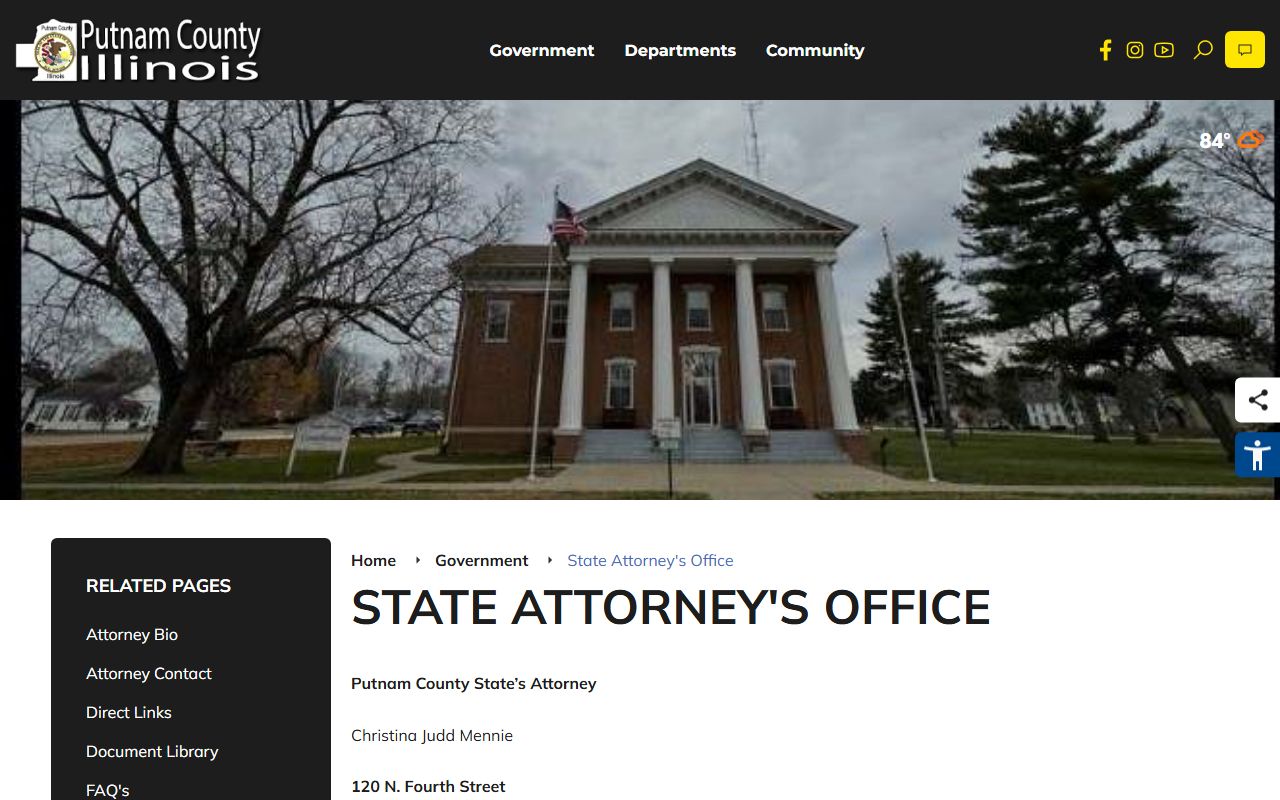
That same office points the public to Illinois VINE for custody and case alerts, with registration online or by phone at 1-866-566-8439.
Note: A FOIA request to the State's Attorney is for case records and warrants, not for general legal advice or for confirming day-to-day jail custody.
Restricted Court Records After an Arrest in Putnam County
Not every record after an arrest is open. Juvenile cases are restricted, sealed charges are hidden from public view, and an ongoing investigation can keep certain reports out of reach until a case decision. Records tied to a case the office has not finished reviewing may also be withheld until a final determination is made.
When an online search comes up short, the path is the same as for any court record here: contact the Circuit Court Clerk for the official file, or file a FOIA request with the right office for what is releasable. Restricted does not always mean closed, and the clerk can explain what is available.